
Some of the links in this post may be affiliate links. See our disclosure for more info.
Taking care of yourself is always important we’ve put together a list of 15 simple self-care tips to help you get started.
The idea of self-care is everywhere these days – accompanied by pictures of amazing bubble baths, perfectly made beds, and secluded resorts
But what really is self-care? And why should we be doing it?
At its heart, self-care is much more than just having a hot bath and an early night. It refers to a whole range of activities that are carried out with the intention of reducing stress, enhancing energy, and restoring health.
This isn’t about being selfish. It’s about deliberately taking time for yourself, and recognizing that doing so is an important part of your physical, mental, and spiritual wellbeing.
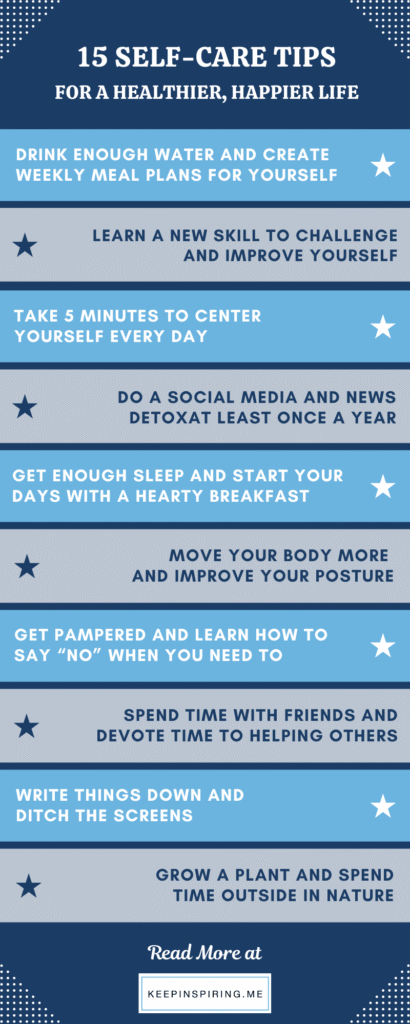
Keep reading to find out the small changes you can implement in your life to benefit your mind, body, and soul.
1. Start Your Day with Water
Most of us are dehydrated – we simply don’t get enough water. The Institute of Medicine recommends that we drink ten cups of water each day, but most of us are only managing about 1.8 cups.
That’s a huge discrepancy, and it basically means we aren’t drinking nearly enough for our bodies to function at their optimum level. As a result, about 75% of Americans are chronically dehydrated every day without even knowing it.
Dehydration can make us feel tired, physically and mentally, severely affecting our performance. Brain fog, irritability, and a dip in cognitive ability can all result from not drinking enough water.
Dehydration can also leave us prone to both headaches and dizziness.
Drinking more fluid is the best way to start combating the effects of dehydration, but not all fluids are created equal.
Avoid tea, coffee, soda, and alcohol, as well as high-sugar drinks like fruit juice.
Drinking pure water is the best way to stay hydrated, and one of the best and most simple methods of self care is to start each day with a glass of water.
That way, before you do anything else, you’re setting up your body to get what it needs to function at its best.
Buy a reusable water bottle and make drinking enough water a habit. It might seem difficult at first, but soon you’ll start to see the benefits of being properly hydrated – more energy, clearer skin, less bloating, and fewer headaches.
2. Create a Weekly Meal Plan
Many of us know that we could and should be eating better. In fact, losing weight is one of the most popular choices for those who set a New Year’s Resolution in January.
However, 80% of resolutions fail in just six weeks, which means those of us who resolve to improve our diet, eat better, and lose weight, are sadly falling by the wayside by Valentine’s Day.
The reason so many resolutions fail is not necessarily lack of motivation, but lack of planning.
Peter LePort M.D, Medical director of MemorialCare Surgical Weight Loss Center at Orange Coast Medical Center, tells us that advance planning is the key to success. “By pre-planning your meals you can often eliminate the impulse, ‘pressed for time’ purchases.” You know the ones we’re talking about: fast food at the drive-thru, candy bars at the cash register, or doughnuts in the office.
Creating a weekly meal plan is one of the most effective forms of self-care.
Taking time, once a week, to write down a detailed plan of attack will make you feel better prepared and help you stay on track. Make a shopping list and stick to it. You’ll enjoy healthier food, find it easier to say “no” to curveball treats, and you might even save yourself some money, too!
3. Learn a New Skill
Whether it’s pilates or yoga, a gym class, or a language class, challenging yourself to try something new can give you a real boost.
Your brain is subject to the same “use it or lose it” theory as the rest of your body, which means that it thrives on new challenges.
Taking a new class, learning a new language, adopting a new skill – these are the kind of things our brains thrive on.
Fitness classes can help us to meet new people who share our goals, while the benefits of yoga – sleeping better, reducing our stress levels, breathing better, and boosting our immune system – are linked closely to the practice of self-care.
Ever wanted to learn Italian, brush up on some Mandarin before a business trip, or talk like an American from the movies? Software and apps make it easier than ever to learn new languages right from home, too.
It doesn’t have to be a new year, new month, or even a new week to try something new. Whether you’re starting a new skill from scratch or returning to something you gave up a long time ago, it’s never too late to start learning.
4. Take 5 Minutes for Yourself
This might be the most challenging item on the list because we are so used to seeing and meeting the needs of others. But at its heart, self-care is about taking time to improve our own wellbeing.
Deliberately making time in your schedule to do something that you enjoy and makes you feel good is ultimately the aim of self-care.
That starts with making time for yourself daily. Whether it’s first thing in the morning over coffee, at the end of the working day, or before you go to sleep at night, take 5 minutes to just be.
There is a misconception that “self-care has to be expensive and lavish, but it doesn’t,” says author Alexandra Elle. In her book, Growing in Gratitude, she reminds us that self-care can be about something as simple and important as simply taking time to breathe.
Put down your phone, stop what you’re doing, and sit still with your own thoughts. Decompress and let go of everything that has happened so far today, and take some good deep breaths.
Taking 5 minutes to yourself every day reminds us that we can’t serve other people from an empty cup. Only when we work on filling ourselves up can we serve others from the overflow.
5. Get an Early Night
I know I said that self-care wasn’t just about bubble baths and getting an early night, but sleep is a crucial part of good self-care.
We’re told all our lives that we should be getting a solid 8 hours of sleep per night, but the reality is that at least 40% of Americans are routinely getting far less than 7 hours of sleep.
There are so many benefits to getting enough sleep, but most of us are still wandering through our days as though we were running on empty.
Set aside a couple of nights a week to slow things right down and get to bed early. Avoid looking at your phone, tablet, or even the TV before bed.
Instead, have a hot bath or shower, put on your PJs, read a book or magazine, do some puzzles, or play a game.
The blue light emitted from devices like smartphones, tablets, and laptops actually interrupts our natural circadian rhythm, which is why Harvard researchers suggest going screen-free at least two or three hours before bedtime. Try it and see.
6. Do a Social Media Detox
If you’re tired of seeing the same old recycled news, outfit posts, or photos of celebrity pets, why not take the opportunity for a detox?
A social media detox could mean switching off from Instagram, Facebook, or Twitter – or it could mean switching off from all 3. Many of us use social media websites out of boredom, but there are so many positive things we could do with all those wasted hours spent scrolling.
Psychology Today has written extensively about the link between social media, isolation, loneliness, and poor mental health among young people and adults.
The desire to use social media “successfully” and our desire to appear successful to others can heighten feelings of anxiety, depression, paranoia and loneliness.
Recognizing that there is more to life than social media, setting boundaries for engaging with others online, or doing a cold-turkey detox is one of the best ways for you to take care of yourself today. If you still find yourself feeling isolated, there are many better things to do when you feel lonely.
7. Eat Breakfast
Many of us skip the “most important meal of the day,” but sitting down for breakfast is a great way to take care of yourself. Eating a nutritious breakfast sets the tone for the rest of the day.
Back in the 1960s, nutritionist Adelle Davis said: “Eat breakfast like a king, lunch like a prince and dinner like a pauper.”
The wisdom still holds: eating breakfast sets you up for the day, curtails snacking, and allows you to load up on lean proteins (like eggs), healthy fats (like avocado), and slow-release carbohydrates (like wholemeal toast or oatmeal).
There’s a causal link between those who eat later, and health risks for obesity, diabetes, and cardiovascular disease.
Whether you’re actively trying to lose weight, or just looking to fuel your body in the most efficient way possible, making breakfast a priority is a great idea. It’s also a good way to slow down your morning routine and enjoy some quality time with family around the breakfast table.
8. Get Pampered
Pampering means different things to different people, but it fundamentally boils down to the same thing. Do something luxurious that makes you feel happy and relaxed.
Whether you enjoy soaking in a tub full of bubbles, bringing the girls together for a face mask party, getting a pedicure at your local nail salon, or booking a deep tissue massage, the self-care message is: do it.
Getting a regular massage, manicure or pedicure, or just indulge in some relaxing time at home. A few candles by the bath, a new moisturizer, or a subscription to a beauty box can be just the invitation you need to have a night of pampering on a regular basis.
9. Move More
We all know that we should be doing some kind of exercise to maintain a healthy physique, but it can be difficult to fit it around day to day life. Doctors at the Mayo Clinic suggest that we do 30 minutes of moderate physical activity each day.
That doesn’t have to mean sweating it out at the gym or in a fitness class – it can be something as simple as a brisk walk, swimming, or even mowing the lawn. If you live in a poor climate, consider buying a treadmill or stationary bike to use inside.
Staying active is an important part of any daily routine because it helps support a healthy body and a healthy mind.
Struggling to commit to 30 whole minutes? Well, why not take 3 brisk 10 minute walks throughout the day. Here are some other fun suggestions to help you move more:
- Have a dance party – clear the floor, put on your favorite tunes, and bust out those moves. It doesn’t matter if you’re alone, with flatmates, or dancing with the kids. The important thing is that you’re moving your body and having fun.
- Get an old second-hand bike and see your neighborhood in a whole new light. Maybe you haven’t been on a bike since you were a kid – now’s the perfect opportunity to see if its really as easy to get back on as they say it is.
- Break out the vacuum cleaner and give your home a good once over. It’s a real workout!
10. Grow a Plant
Nurturing plants can have major therapeutic effects, according to Psychology Today. Whether you have a garden or just a small space on your kitchen windowsill, growing plants reveals the inner nurturer in all of us.
Caring for plants and gardens has had a transformative effect on many people, and can really boost self-esteem.
Whether you’d like to grow flowers, herbs, or a tomato plant, start by researching how it grows, where it can thrive, and how to look after it. Then, visit your local nursery and speak to a specialist who can help you find your green thumb.
Growing and taking care of plants can be incredibly rewarding as well as relaxing. It’s easy to account for your progress if you’re growing something from seed!
Horticulture also involves rhythmic and repetitive actions, like watering, weeding, trimming, and sowing, which all promote feelings of peace and contentment.
11. Work on Your Posture
Your mom was right when she kept telling you to sit and stand up straight. “Poor posture can have many negative effects on your health,” says Dr. Kenton Fibel, a family medicine physician specializing in sports medicine at Cedars-Sinai Kerlan-Jobe Institute in Anaheim, California.
From poor circulation to jaw pain, fatigue, headaches, and sexual dysfunction, there are more than a few reasons for you to focus on sitting and standing up straighter.
For many people, it has become second nature to sit hunched over their desk – whether at work or home.
Instead of slumping, try sitting up straight in your chair, placing your hands on your thighs and squeezing your shoulder blades together. Hold for five seconds before releasing, and repeat three or four times throughout the day.
12. Write Things Down
The advent of notes and journaling apps on phones and tablets mean that we are actually writing things down less than ever before. However, writing our problems on paper is a really valuable, meaningful and practical way of practicing self-care.
Growing in Gratitude author Alex Elle recommends confronting any negativity you might have on paper: “Write down the lies—the negative self-talk, self-doubt—and then combat that with what you know to be true, what you’re capable of,” Elle says. “Putting that on paper helps to acknowledge the negative, while not letting it overtake the positives in your life.”
You don’t just have to write down the negatives, either. Take the opportunity, everyday, to write down in a notebook 5 things that you are grateful for today.
Whether it’s a great day or a terrible one, we all have things we can be thankful for: a home, a car, being able to drive, two legs to walk around on, being able to see, friends who care about us, a comfortable bed…
Gratitude isn’t just about the large gestures – it can be as simple as being able to recognize the positive, routine things that happen to us day in, day out.
13. Spend Time With Friends
It’s really easy to say that we are simply too busy to make time to spend with friends. Making time for yourself is an important part of self-care, but so is making time to see others.
Schedule a day or evening, once a month, where you meet up with friends and fill each other in on what has happened in the last month. That way, even if you drop the ball on texting or calling in the meantime, you’ll know that you can catch up again soon.
Having a regular event on your calendar will give you something to look forward to. This is an especially important part of self-care for those with anxiety or depression, who might avoid interacting with others when they feel down.
Meeting up regularly avoids feelings of isolation and loneliness, and can be a welcome distraction from other worries.
14. Help Others
Perspective can be a great lesson, and helping others can be a great way of practicing self-care.
Psychologist Dr. Nancy Irwin says: “If everyone volunteered just one hour a month, imagine the difference it could make in the world!” And she’s right. Volunteering your time once a month, just for an hour, can make a huge difference to your local community and to yourself.
When you choose to volunteer at a local homeless shelter, soup kitchen, or children’s shelter, you’ll help those who have far less than you do. You’ll also meet new people and put your talents and skills to good use.
Whether you make a donation or give up your time, you’ll feel like you’re making a big difference to someone’s life. And really, you are – you’re making a difference to your own.
15. Learn To Say No
Last but not least, caring for yourself means learning to say “no.”
Have you ever committed to working some overtime hours, then immediately regretted it because you already feel exhausted? Or told a family member you’d help them move some boxes into a storage unit on your free weekend?
We’ve all been there. You want to say no, but you feel obligated – like you’ll let someone down – if you don’t say yes. So, reluctantly, you agree to do it… then spend the rest of the time wishing you hadn’t.
Erica M. Wollerman, Psy.D., psychologist and founder of the Thrive Therapy Studio says: “Our expectations of ourselves in different situations are unrealistic so you most likely are not able to do all the things you might think you need to do — and that’s okay.”
As humans, we are hardwired to want to say yes to everything, and feel guilty if we can’t do it all – that’s why we make long lists of things we need to do. But as Wollerman reminds us: “You are more important than your to-do list, so prioritize your well-being above some of the little extra tasks you might think you need to do.”
Though you may feel that you “lose out” in the short term, saying no can actually be very liberating. Letting go of the expectation that we must do it all, always be ready to go, or put others ahead of ourselves is what self-care is all about.
Why should we prioritize self-care?
Well, it can have huge benefits for our physical health.
The “relaxation response” that is triggered when we do the kind of things listed in this article acts like an “off switch” for the body’s fight or flight response.
Our blood pressure and heart rate are lowered, our digestive system is allowed to function normally, and our hormonal levels of adrenaline and cortisol can return to normal levels.
In terms of our mental health, self-care is a vital to the successful management of depression and anxiety disorders. And finally, self-care actually improves our relationships with those around us.
When we avoid emotional burn-out, boost our self-esteem, and banish feelings of resentment through practicing self-care, we actually make ourselves better able to relate to, and care for, others.
Once you create your own daily self care checklist, you can start developing positive habits that will benefit your overall wellbeing.
Is there something you do for yourself that we have left out? If so, let us know below and stay inspired.